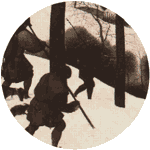
Hunters in the Snow by
November 1999
The art that I truly and enduringly love, the art that never loses its fascination for me, tends to be the art that captures me the very first time I see it.
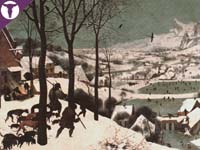
Bruegel is a perfect example of this. I first encountered his wonderful work in the kitchen of a friend’s house. One wall of her kitchen was wallpapered, so to speak, with postcard-sized reproductions of famous works of art, and one of those works of art was Pieter Bruegel the Elder’s Hunters in the Snow (or Winter, as it’s properly titled). It was love at first sight. I walked right into the picture behind those hunters, and I’ve adored the painting ever since.
At the time, I didn’t even know who had painted the picture. I think that, on this kitchen wall, the painting was called “The Return of the Hunting Party” or something like that, and I don’t recall that the name of the artist was given. I don’t remember ever asking my friend if she knew anything about the picture; I just examined it quietly each time I was at her house, and at some point I managed to put painting and artist together, and that was that.
What fascinated me initially about Hunters in the Snow is that it made me feel cold just looking at it. Looking at this painting is like standing in an open doorway and looking out at a wintery landscape. You can see your breath when you look at the painting, you can feel the bitter chill on your cheeks. The colors are harsh - black, white, blue-grey - the colors of a world that has not seen warmth or sunlight for a very long time. The sky is as flat and unforgiving as the sheets of ice covering the rivers and lakes in the valley. The trees, spidery and bare, jut lifelessly from the frozen ground, and the wiry brown tendrils of the plant in the foreground are being smothered by snow.
The perspective of the painting invites you to walk into that wintery world, even though that world is more harsh than inviting. The trees on the left side of the painting march in a straight line down the hill, and the hunters and their dogs follow. You are made to feel as if you are a part of the hunting party, as if you, too, will soon reach the crest of the hill and then begin your descent into the cozy valley below.
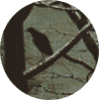
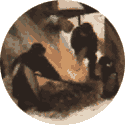
It’s this trick of perspective that startles me and draws me in every time I look at the painting. You can hear the hunters crunching through the deep snow, their breathing ragged from the exertion in the freezing air. You can hear the hunting dogs panting, the distant laughter and shouts of the children cavorting on the ice of the lake, and the occasional mournful cry of the black birds circling overhead. You can even hear the fire crackling in front of the tavern to the left, and you can smell the woody smoke on the winter air.
The colors of the paint have undoubtedly changed and darkened over the course of the centuries (Hunters in the Snow was painted in 1565), but that’s done the painting no harm from an aesthetic point of view. Bruegel was able to perfectly capture the light, the feel, the atmosphere of a late winter afternoon in the countryside. Exactly what countryside it’s meant to be is a mystery - there certainly aren’t any mountains like that in Holland. But Pieter Bruegel did take a long trip to Italy, so he was certainly familiar with mountains. And anyway, exact locations don’t matter. The painting Winter is the archetype of winter, the Idea of winter. It can be any winter you want it to be, anywhere you think it should be. The fact that the painting is unconstrained by an exact location is part of what gives the work its enduring quality.
I think that Hunters in the Snow is more constrained by a sense of time than of place. Despite the fact that the year 1565 is not really the Middle Ages anymore, Hunters in the Snow perfectly captures my concept of what the Middle Ages was like: cold, brutal, fairly miserable, and real. Perhaps it’s that aspect of Bruegel’s paintings that intrigues me most of all: his subjects are so detailed and so realistically portrayed that they seem to be able to march right off of the canvas and into our world.
The hunters may have apocryphally given their name to the Bruegel’s painting Winter, but they are not the real focus of the painting, or the only focus. The focus is on winter itself, and they are but one detail amongst numerous others that bring Bruegel’s painting to life. The longer you look at Hunters in the Snow, the more there is to see. There are tiny villages, churches and towers scattered throughout the valley. The houses have tiny windows, tiny smoking chimneys, tiny icicles dangling from the rooftops. There are little horses and wagons, miniature bridges, microscopic barrels lined up in front of buildings.
But the most miraculous thing of all is that there are people everywhere - people so small that you can only get a good look at them if you see enlarged details of the painting. It’s worth it to look closely, because every tiny person is different. The frozen lake is covered with ice skaters. There are couples skating together holding hands, and there are children playing with wooden toys or chasing each other across the ice. There is a mother with a child, there are boys with a sled, there are skaters skating elegantly on their own and there are some who have fallen flat on their faces (Bruegel had a sense of humor). There are people sitting at the edge of the lake putting their ice skates on, and there are others who are just watching.
Apart from the skaters, there are people working: a woman carries a bundle of bare branches, a man drives horses along a road, a group of people climb up ladders to reach a chimney that appears to have flames blazing out of it - and on and on and on, the little figures continue into the distance until they are no more than dark specks, and it is impossible to see what they are doing - but you can be sure that they’re doing something.

I was lucky enough to be able to see an exhibition of the Bruegel family’s “greatest hits” in Vienna several years ago. It was a huge exhibition of the paintings of Pieter Bruegel the Elder, Pieter Bruegel the Younger (who, amongst other things, did a remarkable job of copying his father’s greatest works), and Jan Bruegel (who, amongst other things, painted gorgeous, velvety flowers). I had to wait in line for quite a while before I got into the exhibition, and as I stood outside I could see Hunters in the Snow from a distance. It was absolute torture; I was literally jumping and squirming, I was so anxious to get in there and get my first real-life look at my favorite painting in the world.
It was the first painting you saw when you walked into the main room, and I made a beeline for it and stood there for a very long time in utter awe. I would have given anything to be able to touch the paint. The other paintings were brilliant as well - The Tower of Babel was breathtaking - but it was Hunters in the Snow that I kept going back to, and Hunters in the Snow was the last thing I saw as, after hours of being immersed in the art of the Bruegels, I left the exhibition and looked back through the doorway one last time.
I will never, ever cease to be amazed at the depth and detail of Hunters in the Snow. I could probably say that about every Bruegel painting I have ever seen, whether I have seen it in a museum or in a book. Bruegel’s paintings are sometimes like photographs, accurately and objectively capturing the people and things that populated his world and his imagination. He portrays his world with a real sense of affection and without condescension. As harsh as their lives may have been, his subjects appear to be hard-working, endearing people with a great potential for joy and fun.
Bruegel has managed to make his world almost as real to me as my own world is. And each time I crunch along the frozen ground in the blue light of a late winter afternoon, I see my breath on the chill air, I can smell the smoky fire and I feel like I’ve walked into Bruegel’s winter wonderland.