Jessica Makes Pasta by
July 2004
As a self-proclaimed foodie with a passion for Italian food, it was only a matter of time before I found myself being enticed by the thoughts of making my own pasta.
My dreams of homemade pasta were stoked by stories of the noodles made by my grandfather on my mother’s side (who was Italian-American) and my great-grandmother on my father’s side (who was not). In a way, it was a matter of family pride to want to revive and carry on these culinary traditions. It was also a matter of wanting to recreate the delicious fresh pasta that Jeremy and I had every day in Bologna. And it was a matter of thinking that being able to make my own pasta would be just plain cool.
And so it was that on my thirty-first birthday (which, at the time of writing, was just two days ago), my loving husband took me on a tour of all the kitchen shops in Brighton so I could pick out the pasta maker of my dreams. It was pretty slim pickins’, but by the end of the shopping day, I had my gleaming Imperia pasta maker - and a lovely marble mortar and pestle to boot. Happy birthday to me!
I embarked on my first pasta-making adventure the day after my birthday. As per the pasta machine’s instructions, I did a few trial runs with some throw-away dough to clean out the pasta-maker’s steel rollers, and then I got down to the real thing. First, the dough: two cups of fine Italian flour, 3 eggs, and nothing else. The dough came together very easily, and though I was anxious to get to the rolling and cutting bit of the pasta-making process, I wrapped the dough in plastic wrap and set it in the fridge for a while to “rest”.
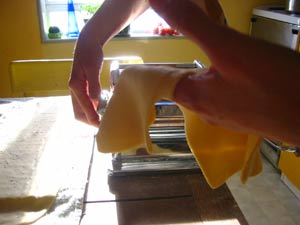
After the dough had rested and I had covered the kitchen table with lightly floured towels for holding the rolled-out pasta, we were ready to go for real. First, the dough has to go through the machine a couple of times with the rollers set to the widest setting; this “kneads” the dough and makes it silky smooth. After that, you start moving the machine’s rollers closer and closer together so your dough gets thinner and thinner - and longer and longer. You crank the dough through the machine…

…and then you discover that it’s helpful to have another pair of hands available, because it’s not so easy to hold the dough and turn the knob to adjust the rollers at the same time.
I found the dough to be remarkably resilient though. It was smooth and stretchy, but it wasn’t sticky, it didn’t tear, and it withstood a lot of manhandling. Maybe this was beginner’s luck on my part, but I was quite pleased with the texture of the dough.
Anyway, the dough goes through again and again until it’s the thickness you want:

And then, because the dough is tired from all the rolling, it has to have another little rest on its floury towels. Actually, it just needs to dry out a bit before you can cut it into tagliatelle or spaghetti, or else it will clog up the rollers (a lesson I learned the hard way when I was cleaning out the machine with my practice dough and attempted to put still-wet dough into the tagliatelle attachment - bad move).
I didn’t need a rest at this point. In fact, I was so hyped-up by the whole pasta-making thing that I felt to compelled to continue cranking the empty pasta machine’s handle while my dough tried to rest.

The next step was the first really scary step: turning the sheets of dough into strips of pasta. As mentioned earlier, my practice run with the tagliatelle cutter was less than successful, so I wasn’t too sure how this bit was going to go. Luckily, my dough was nicely dry and rested this time around, and with Jeremy’s help, I went from a table full of giant sheets of lasagne to a table full of this:

It was tagliatelle! I couldn’t believe it had actually worked. I couldn’t linger over this triumph for too long, however, because there was actually a dinner to prepare. So while the tagliatelle dried a tiny bit, I put on a big pot of water for the pasta and whipped up some of my Oma’s (i.e., grandma’s) tomato sauce.
I actually look like I’m uttering some strange incantation while waving my hands randomly over the pot on the stove, but as far as I remember, no witchcraft or telekinesis was involved in the preparation of this meal.

When the water for the pasta was boiling, it was time for the next scary step: throwing in my lovely strips of tagliatelle and praying that they didn’t turn into one big, starchy clump in the pot. They didn’t. In fact, they separated quite nicely, turned a good deal paler, and cooked up just like “regular” pasta:

While I tended the stove, Jeremy set the table. Here you can see my new mortar and pestle, filled with the freshly made pesto which was originally intended to be served with the vegetable soup that was supposed to be our main course after a pasta starter. Plans changed when we realized that we had enough pasta to feed an army. The soup had to wait for another day - but not the pesto.
And yes, the kitchen table was still kind of covered with flour from the fresh pasta. What can I say? It’s rustic.

At last, the sauce was ready, the pasta was done, the table was set, and all that was left to do was dish it up into our big pasta bowls…

…pour ourselves some wine and tuck in. The pasta was firm but tender, with a lot of body and a nice “mouthfeel”. It wasn’t gritty, it wasn’t mushy, it didn’t stick together, it didn’t fall to pieces when you twirled it on your fork, and the tangy tomato sauce clung to it perfectly, making every bite a little taste of heaven.
It was just as good as it looks. And I can’t wait to do it all again!
