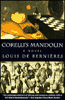
Corelli’s Mandolin by
March 2000

It’s a delicious feeling to be reading the kind of book that draws you in completely and makes the rest of the world disappear. Corelli’s Mandolin, by Louis de Bernières, is just such a book. The more I read, the harder the book was to put down, the faster the hours went by and the later the nights became until finally I had to finish it in a marathon reading session that kept me up until 5 in the morning so that I could find out if everyone lived happily ever after.
The book’s setting doesn’t lend itself to happily-ever-afters - war stories never do. The bulk of the narrative takes place on the Greek island of Cephallonia during World War II. As Greece gets involved in the war, Cephallonia is occupied by the Italians and the Germans. The island’s gradual transformation from pastoral idyll to ravaged battlefield is depicted in heartbreaking detail.
This transformation is observed through the eyes of the book’s characters, who are themselves transformed in the course of the tale. Nothing remains as it once was. When Pelagia, the young Cephallonian woman who is the central character, tells her fiancé at the front to “come back to us after the victory, so that things might be as they were before” (pg. 108), you already know instinctively that things can never be as they were before. The innocence of the island and its inhabitants has already been destroyed by a pointless, hopeless war.
Corelli’s Mandolin is a book of contrasts, contradictions and turnarounds. Enemies become lovers, friends become mortal enemies, peace turns to war, love turns to hate. The structure of the book and the writing itself - at times gorgeous, at times brutal - reflect the contradictions in the story. For instance, Pelagia’s letters to her fiancé are poignant and lovely, filled with the little details of life at home, filled with the sad details of life under German and Italian occupation, filled with love and longing.
The chapter immediately following these letters, however, is a bleak, horrifying, unforgiving description of war as seen through the eyes of an Italian soldier. It’s jolting to go from such beautiful, lyrical descriptions of love to such dreadful descriptions of war, but somehow the two things fit together and complement each other. The love makes the war seem that much more horrific, and the war makes the love that much more precious.
It is de Bernières’ great skill as a writer that allows these contrasts to flow together so remarkably well. There is something Garcia Marquez-esque in his writing. There’s a certain lushness, a lyricism that makes even the brutal descriptions of war poetic in an odd way. The writing encompasses you. It’s moving, but it never descends into pathos. It’s touching but not schmaltzy. There is a pulse to it, as rhythmic as the waves on a sandy Greek beach, or as deliriously fast as machine-gun fire.
This hypnotic pulse draws you deeper and deeper into the book. And the book is, at heart, simply a love story, albeit one of almost Odyssean proportions - as the frequent references to the Odyssey remind us. Each character goes on an Odyssey of his or her own. For some, the journey is explicit, complete with witches named Circe and the lover at the end of the journey who does not recognize her beloved. For others, such as Pelagia, it is an internal journey. Pelagia doesn’t leave the island, but she suffers through trials worthy of Odysseus and she is as steadfast as any Penelope. Her journey is as heroic and transformational as any other.
When I go on an epic journey with characters that are as likable as the practical Pelagia or the charming Captain Corelli, I can’t help but get really emotionally involved with them and their fates. And this leads me to something that I didn’t like about the book: how it ended.
Part of the problem is with the writing that I was just praising so highly. The last chapters have a different tone and a very different pace than the rest of the book. Everything seems a bit rushed. All of a sudden, narrative years go by, and I felt slightly cheated that I didn’t get to be as involved in those years as I had been in the years before.
But the main problem is that I can’t shake feeling that sometimes authors are just not fair to their characters. I first became aware of my problem with this when I read Cold Mountain, a book which bears quite a bit of similarity to Corelli’s Mandolin, what with its love in the time of war theme and all that.
The characters in Corelli’s Mandolin, as in Cold Mountain, go through countless trials, as does the interested reader (in this case, me). With both Cold Mountain and Corelli’s Mandolin I was wrapped up in the story, I was rooting for the characters I’d really come to sympathize with and when it was all over, I closed the book and was left with a vague feeling of dissatisfaction and injustice.
I won’t give away the ending. I’ll just say that I think that the characters in Corelli’s Mandolin deserved better than they got. I know that real life isn’t fair, and I’m not actually a big fan of Hollywood happy ends. But still…when you are the creator - the author - and you create such compassionate human characters, it seems unjust to make your creations suffer so much.
But though the ending was maybe not what I hoped it would be, it was also not as bad as I feared it could be. I didn’t finish Corelli’s Mandolin and throw it across the room in disgust, as I did with Cold Mountain. Maybe I get too attached to characters in books I like.
And there is no doubt that, despite the bittersweet ending, I liked Corelli’s Mandolin. A lot. A whole lot. The story is interesting, the characters are endearing, the writing is excellent, the whole book is amusing and moving. I highly recommend it.
But be prepared to burn the midnight oil reading it.