They Learned to Love the Bomb by
March 2000
Because of that pesky little thing know as “copyright", I don’t think that I can scan in the picture I want to talk about here. The picture is from a newspaper, and since I really don’t want to infringe on anybody’s rights, I’ll just have to describe what’s going on in the photo. You’ll have to use your mind’s eye and let your imagination do the rest.
The picture is from the Sunday paper in Freiburg, the Zeitung zum Sonntag. I cut it out of the paper on May 30, 1999.

First, picture a mosque. No, no, not some sort of Arabian Nights fantasy. This is a modern mosque. Very modern. It is, in fact, the Shah Faisal mosque in Islamabad (if you already know what this looks like, you can skip to the next page). It is, I believe, the largest mosque in the world. On the outside it’s a 12-sided dome with four towering minarets. It’s supposed to look like a huge tent in the desert. It kind of looks like a tent from outer space.
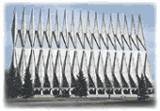
Imagine the inside of the tremendous prayer chamber. The ceiling and the walls appear to meet like interlocking triangles. The ceiling juts down in angles and the walls sweep up to peaks (that’s the space tent effect). It’s hard to imagine, and really hard to describe, I guess because it’s not something you see every day. I’m not sure I’ve ever seen anything like it. Imagine the kind of architecture embodied by the Cadet Chapel at the United States Air Force Academy in Colorado Springs and you’ll pretty much be on the right track.
There is a central peak in the incredibly high ceiling. A giant globe of lights hangs from this peak, and a metal ring with more lights swirls around this globe like the rings that swirl around Saturn. The room is brightly and evenly lit. The walls are perforated all the way to the ceiling to let the light in, and the ceiling appears to have skylights. It is clean and bright and airy to the point of sterility.
Picture the people in this room. Imagine a sea of men, most of them dressed in white, all of them kneeling, all with their heads bowed to the floor. A sea of bent backs. The mosque can hold tens of thousands of people. There is row upon row upon row of worshippers, too many people to count, thousands of people praying together beneath that glittering globe of lights.
Despite the fact that the mosque is huge and spectacularly modern, the picture itself it not really so odd. But here’s what the caption says (translation from the German is mine):
“Praying for the Bomb: Thanksgiving in Islamabad on the first anniversary of the detonation of a Pakistani atomic bomb. This macabre anniversary comes around just as hostilities between India and Pakistan have reached a new high point. Even though on Friday Pakistan’s President Sharif signalized his readiness to reach a compromise, the Indian air force continued its attacks on Moslem guerrillas in the border region of Kashmir.”
I get chills every time I read that. So many thousands of people in a religious building, a sacred building, on their knees, thanking their Higher Power for nuclear weapons. Is that…holy? Was a weapon of mass destruction the answer to their prayers? Is the atom bomb really a gift from God or Allah or whomever?
The picture reminded me of a show I once saw about nuclear energy and radioactive waste. The theory was postulated that, at some point in the future, there would be so much deadly radioactive waste that the stuff would not only have to be sealed up in bunkers in the middle of nowhere, it would have to be watched over permanently by a sort of “nuclear priesthood.” This nuclear priesthood would be an order of people whose only task would be the maintenance of the bunkers and the preservation of the knowledge of the dangers of nuclear waste.
I thought the phrase “nuclear priesthood” was absolutely brilliant. It’s the perfect combination of science and religion. It somehow unifies the mysteries of the atom with the mysteries of God. It conjures up images of acolytes wearing robes embroidered with the symbol for radioactivity. Of high mass held in missile silos. Of a very bleak future indeed.
I decided that someday I would have to write a book about nuclear priests. I imagined a sort of future-primitive society in which all knowledge of nuclear power and radiation had been lost and the nuclear priesthood had disappeared. The radioactive waste bunkers would be considered places of evil spirits. The ignorance of the populace would lead to one or more of the bunkers being opened, thus unleashing radioactive destruction upon the land (oh no!). Our Heroine (or Our Hero) would have to believe that the nuclear priesthood was not in fact long gone, and she or he would have to track down the last of the nuclear priests in an attempt to save the world.
I never got beyond that stage. But I haven’t yet written off the idea of writing a trashy novel someday. However, I assumed that such a book would have to be science fiction. Science fiction.
And then I saw this picture of the mosque. And I read the caption. And I pondered the implications. And I realized that the idea of a nuclear priesthood isn’t really so far-fetched and science-fiction-y after all.
It’s not a very comforting thought.
