No harmless drudge. by
April 2005
Today is the 250th anniversary of the publication of the first edition of Johnson’s dictionary. If you love words and you love history, you have to love Johnson’s dictionary: not only was it one of the first comprehensive dictionaries of the English language, it’s also packed with 18th-century social commentary, and it’s a riot to read.
And how could it not be? Samuel Johnson was a real character, and that character shines through in his dictionary’s entries. There is, of course, the famous definition of oats: "A grain, which in England is generally given to horses, but in Scotland supports the people" (Johnson wasn’t terribly impressed with Scotland). Or how about methinks: "This is imagined to be a Norman corruption, the French being apt to confound me and I." Or the entire section of the dictionary for the letter X: "X is a letter, which, though found in Saxon words, begins no word in the English language". Or the charming definition of elephant: "The largest of all quadrupeds, of whose sagacity, faithfulness, prudence, and even understanding, many surprising relations are given." Or the little asides that provide great insight into how people spoke and wrote in 1755 (at least according to Johnson): restrict is "a word scarce English"; enact is "not now in use"; to chat is "to talk of. Not in use; unless ludicrously" (ludicrously, in this case, meaning "sportively; in burlesque; in a manner that may excite laughter").
The list could go on. Needless to say, Johnson’s approach to lexicography was somewhat less objective than what we’re used to today, but that’s a good thing - that’s what makes the dictionary so eminently enjoyable to read. Every page you turn to is a window onto another world and onto the mind of a man who (almost) single-handedly took on the task of documenting the English language, and who did it with such chutzpah (not a word to be found in Johnson’s dictionary) that you can’t help but feel affectionate towards him.
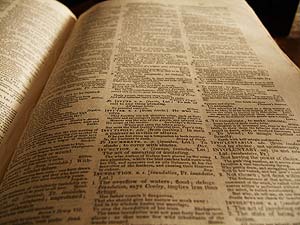
Below is a picture of my own musty, beaten-up copy of Johnson’s dictionary. My version was published in 1828, which was, incidentally, the same year that the first edition of Webster’s was published - a dictionary which was equally important, but probably not half as much fun.