America's schoolmaster. by
April 2005
April is a busy month for philologists, it seems: today is the 177th anniversary of the publication of the first edition of Webster’s American Dictionary of the English Language.
Even in the decades before the publication of this famous dictionary, Noah Webster was working busily to revise and codify the spelling and pronunciation of American English. Early on in his career, he published essays pushing for a massive reform of English spelling. While there’s no doubt that English orthography is irregular to the point of seeming completely irrational ("tough dough", anyone?), some of Webster’s proposed changes make me - well, laf, to use Webster’s proposed spelling. Webster’s reasoning is interesting as well: he said that cutting silent or superfluous letters from words (e.g., writing bred instead of bread, or bilt instead of built) would not only make it easier to learn English and save money on printing (because fewer letters would mean shorter books), it would also "make a difference between the English orthography and the American…an event [which] is an object of vast political consequence."
Living as he did during the American Revolution, Webster was very keen to draw a line between "English" English and "American" English. This was not only for political reasons, however. Webster was a prescriptivist in the extreme, and he saw linguistic corruption at every turn. He felt that the English of Great Britain was "on the decline", and so he campaigned for a uniquely American standard, a fresh start with a system of spelling and pronunciation so perfectly uniform that it would "almost prevent the possibility of changes".
The majority of his most radical changes have, obviously, never been adopted (we still write machine and not masheen). But Webster still had a tremendous influence on how Americans write. His American Spelling Book taught countless 18th- and 19th-century Americans to read and spell. And both Webster’s first dictionary (published in 1806) and his more famous American Dictionary introduced several of the key features which now distinguish American spelling from British spelling - such as dropping the "u" in words like colour and flipping around the final letters in words like centre (yes, he was responsible for all that). His dictionaries were also the first to include uniquely American words like chowder and skunk, which set these dictionaries apart from ones like Johnson’s (intriguingly, however, even in the American Dictionary, the entry for oats mentions the Scottish, saying that oats are a "very valuable article of food for man in Scotland, and every where oats are excellent food for horses and cattle.")
But poor old Noah - he subsequently got embroiled in The Dictionary Wars and had to watch his former assistant become his arch lexicographical rival. And when Webster died, the rights to the Webster name were snapped up by the brothers Merriam, whose company went on to revise Webster’s dictionary in a way that Webster would probably have been pretty peeved about; these revisions included taking out Webster’s Biblically-based word etymologies and replacing them with something rather more linguistically reasonable.
However, Webster might be heartened to know that his name has now become synonymous with "dictionary" in America. And - strictly religious man and fierce prescriptivist that he was - he might be even more pleased to hear that Christian groups are busy peddling his 1828 edition of the American Dictionary in an effort to counteract "the erosion of vocabulary acted upon by godless philosophies" and the dangers of lexicographers who would stoop so low as to include "contemporary usage" and "slang" in their compendia of the English language.
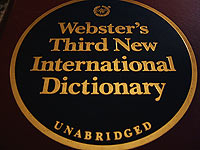
Below is a picture of my own massive copy of Webster’s Third New International Dictionary - a controversial edition, to be sure, particularly among the "language mavens" who deride its descriptivist approach to documenting English usage. But controversial or not, it’s the dictionary I reach for when the late-night conversation turns to "where’s that word come from, anyway?" And at a whopping 2,662 densely-written pages, there’s enough in that dictionary to keep any word-lover occupied for a very, very long time.